
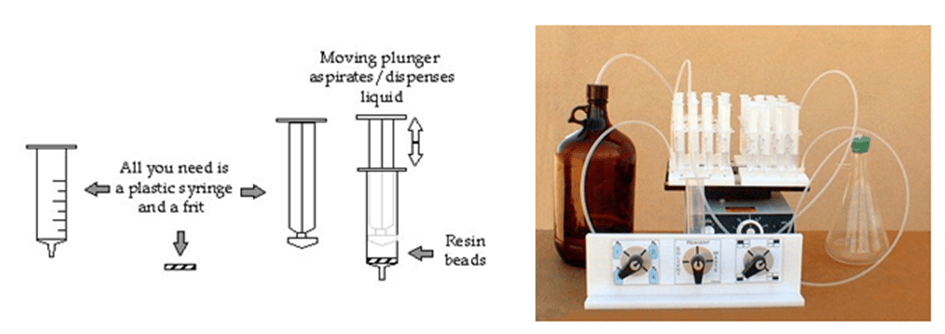
One part of our group is dealing with diversity-oriented synthesis (DOS) on polymer-supported resin. DOS aims to generate structurally diverse and stereochemically complex molecules starting from simple, commercially available building blocks. Using this methodology, many structurally distinct compounds can be produced in a relatively short period of time. In combination with solid-phase synthesis, it opens up new opportunities to find compounds with novel binding modes and therapeutic effects. Solid-phase synthesis has been frequently used in the search for biologically active compounds and their modification thanks to several significant advantages. The most important one could be considered a simple implementation of parallel synthesis in polypropylene fritted syringes, where no purification of synthetic intermediates is required, and thus huge compound collection libraries could be rapidly prepared and isolated.
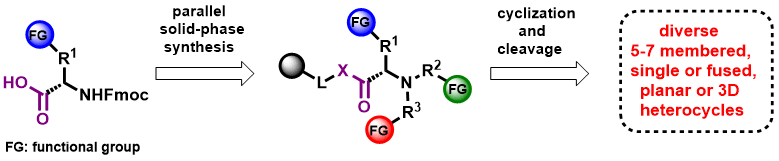
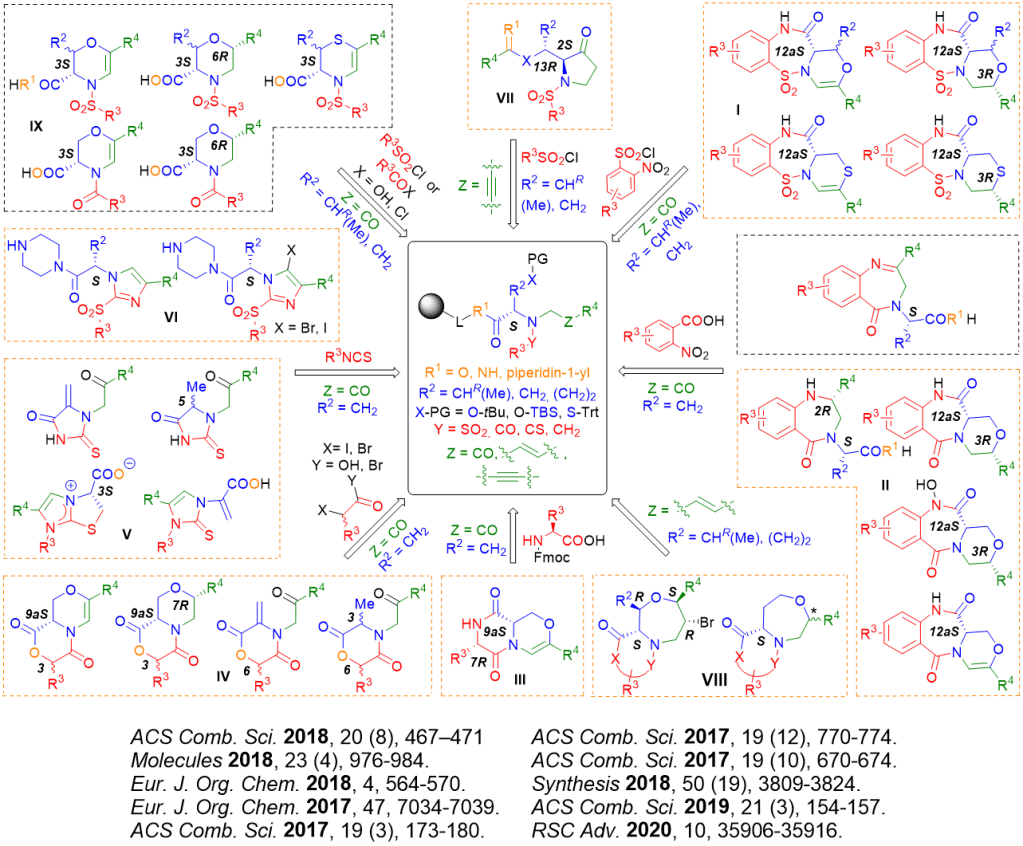
Combining these two concepts, we have started diversity-oriented solid-phase synthesis (DOSPS) from side-chain functionalized, natural, or non-natural amino acids immobilized via C-terminus to the polymer-supported resin. Those are subsequently converted to linear intermediates bearing three functional groups suitable for cycloaddition or cyclocondensation which could lead to diverse heterocyclic scaffolds. Our initial efforts were devoted to immobilized serine or threonine. After sulfonylation of the amino group with nitrobenzene sulfonyl chlorides followed by alkylation with bromoketones, the key intermediates reacted with various electrophiles, yielding a set of different scaffolds. More than 200 representative compounds were prepared with the use of applicable building blocks.
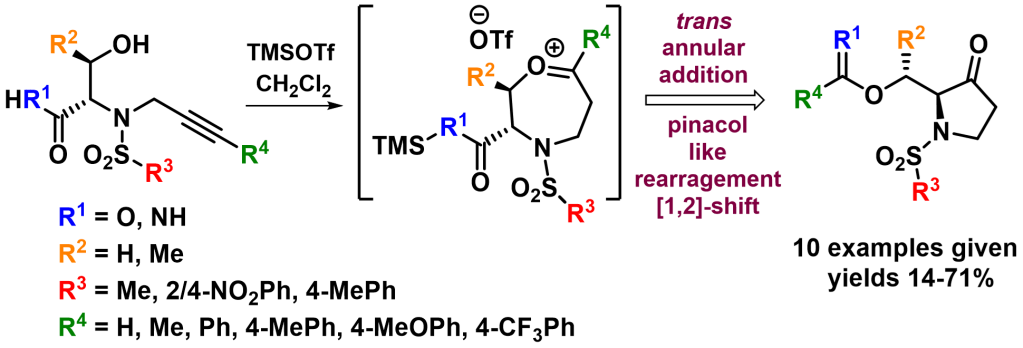
We also discovered a new pinacol-like rearrangement leading to chiral pyrrolidinones, when N-(3-phenylprop-2-yn-1-yl)-sulfonamides derived from serine and threonine were subjected to a reaction with trimethylsilyl trifluoro-methanesulfonate (TMSOTf). In contrast to a previously reported formation of 1,4-oxazepanes, this reaction afforded pyrrolidin-3-ones. A mechanistic explanation for this unexpected outcome was proposed, and the scope and limitations of the rearrangement were outlined (J. Org. Chem. 2020, 85, 985).
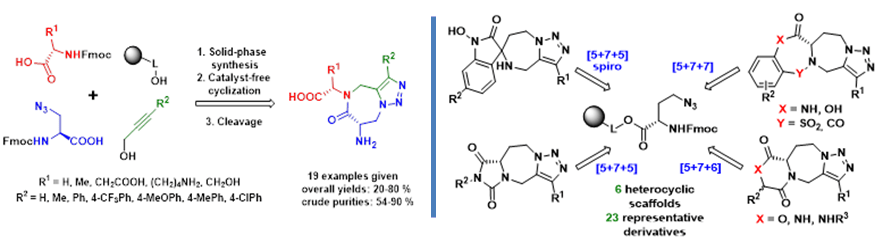
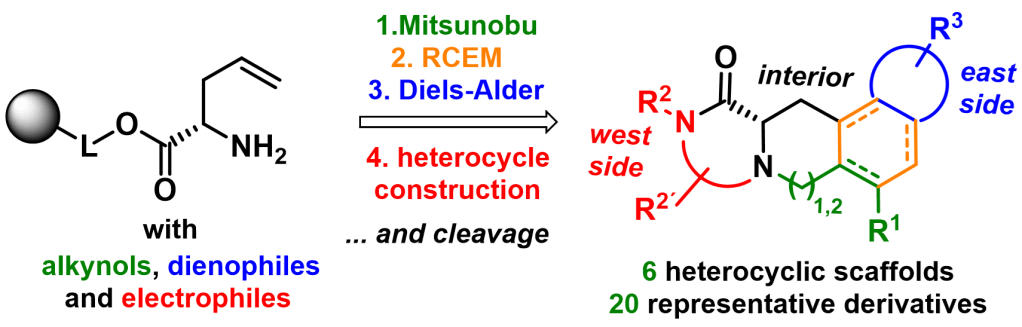
Recently, we replaced serine and threonine with azidoalanine. Immobilized amino acids were nosylated and alkylated with alkynols using Mitsunobu reaction conditions. After denosylation, acylation with Fmoc-azidoalanine yielded linear precursors that were thermally cyclized on resin to give immobilized triazolodiazepinones (Adv. Synth. Catal. 2021, 363, 1112). Moreover, the synthetic approach was applied to convenient solid-phase synthesis of oligopeptide containing a triazolodiazepinone moiety as the peptidomimetic heterocyclic constraint. Alteration of azidoalanine to homoazidoalanine led to diversity-oriented synthesis of tricyclic scaffolds bearing triazoles (J. Org. Chem. 2021, 86, 7963). When alkynols were combined with immobilized vinylalanine, suitable intermediates for ring-closure enyne metathesis were obtained and the resulting dienes were subjected to a Diels-Alder reaction. The method represents a simple tool for the parallel synthesis of complex, polycyclic isoquinolines (J. Org. Chem. 2022, 87, 5242).
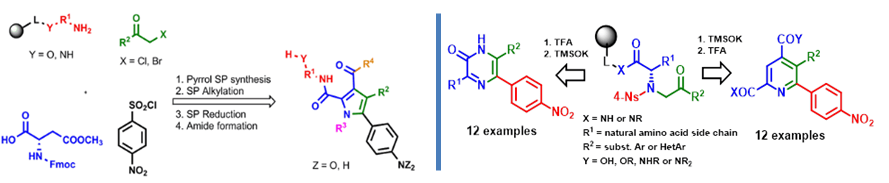
Recently, we combined an immobilized methyl aspartate or methyl glutamate with halo ketones as the alkylating agents. Saponification of a methyl ester triggered a reaction cascade of intramolecular C-arylation, aldol condensation, and aromatization. The discovered pathway enables the fast and simple synthesis of polysubstituted pyrrols, pyridines, or pyrazines using Truce-Smiles rearrangements (Org. Biomol. Chem. 2022, 20, 3811; J. Org. Chem. 2023, 88, 3228).
 Soural group